Booking choice: The Discover Heidelberg Castle guided walk, 2 hours. Book this Tour details
Most castles are famous for being whole. Heidelberg is famous for being broken, and for the choice to keep it that way. The red sandstone wreck on the hillside above the Neckar was the seat of the Prince Electors of the Palatinate, one of the great courts of the Holy Roman Empire, with a garden the seventeenth century called the eighth wonder of the world. Then the French came twice, lightning came once, and the painters of the Romantic age found the result more beautiful than any palace.
This is the story in order, from the first mention in 1225 to the decision in 1890 that made the ruin permanent. The castle's own history and the detailed timeline are the sources where we give dates.
The quick answer
Heidelberg Castle is famous because it is a ruin, and a deliberate one. First recorded in 1225, it became the Renaissance residence of the Palatine electors, with the Ottheinrichsbau and the Friedrichsbau facades. French troops burned it in 1689 and mined its towers in 1693; lightning set it on fire in 1764 after the court had already moved to Mannheim. The Romantics made the wreck famous around 1800, Charles de Graimberg stopped the town quarrying it, and in 1890 a commission ruled it should be preserved as a ruin, with the Friedrichsbau alone restored.
Why is Heidelberg Castle famous?
For being the ruin that Europe fell in love with. The castle's own website calls it "probably the world's most famous ruins", and that reputation was made by painters and poets around 1800.
Three things combined. The building itself was one of the finest Renaissance residences north of the Alps, so even its wreck is grand. The setting is perfect: a red ruin eighty metres above a river town, framed by the forested Königstuhl. And the timing was right. When the Romantics went looking for ruins to feel things about, Heidelberg was the biggest and best placed in Germany, a few hours from Frankfurt on the road south.
Mark Twain, who stayed in Heidelberg in 1878 and described it in "A Tramp Abroad", put it in a line: "A ruin must be rightly situated, to be effective." He also noticed the Great Tun and found an empty barrel the size of a cathedral unmoving, which is fair.
How old is Heidelberg Castle?
The castle's own history gives 1225 for the first documented mention. Other sources cite 1214. Either way, it is early thirteenth century.
The first castle was a fortress of the Counts Palatine of the Rhine, who held one of the most powerful offices in the empire and from the fourteenth century were Prince Electors, with a vote in choosing the emperor. By 1303 the records speak of two castles on the hill. The upper one, further up the Königstuhl, was destroyed by lightning in 1537 and never rebuilt; the lower one is the castle you visit.
Little of the medieval fortress is visible today. What stands in the courtyard is sixteenth and early seventeenth century, when the electors turned a fortress into a palace.
Who built the Renaissance palace?
Three generations of electors between the 1550s and the 1610s: Ottheinrich, Friedrich IV and Friedrich V, whose English wife gave the castle its gate and its garden.
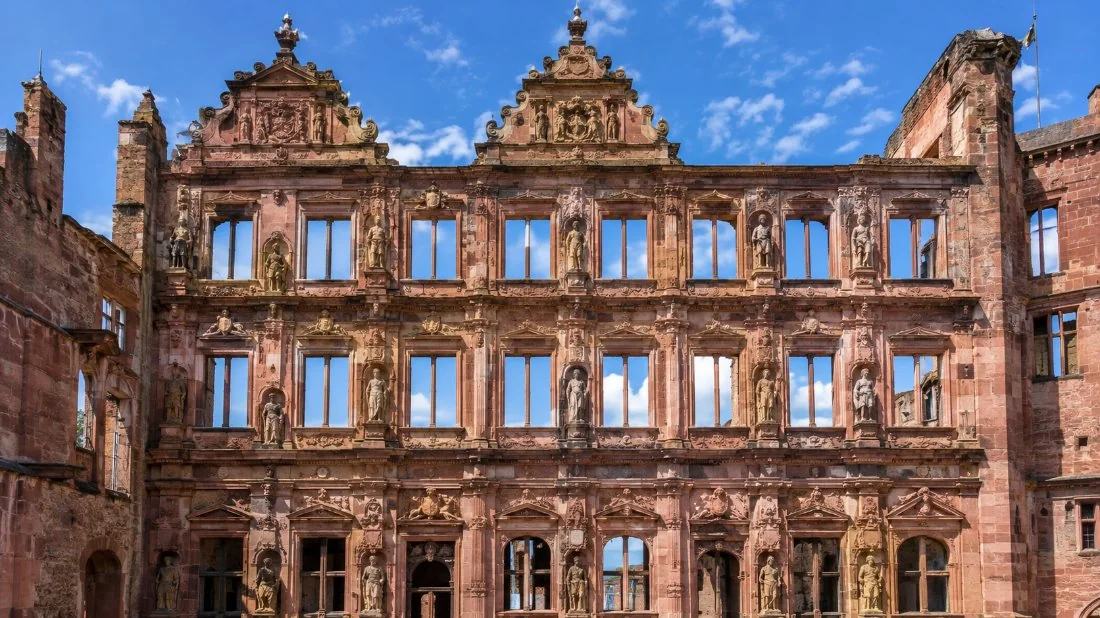
Elector Ottheinrich began the wing that carries his name in 1556, a facade crowded with statues of virtues, planets and heroes that counts among the first Renaissance palace fronts north of the Alps. Friedrich IV built the Friedrichsbau between 1601 and 1607 with the architect Johannes Schoch; its facade is an ancestral gallery of sixteen statues of the Palatine line. The Hall of Glass, the Gläserner Saalbau, stands between them.
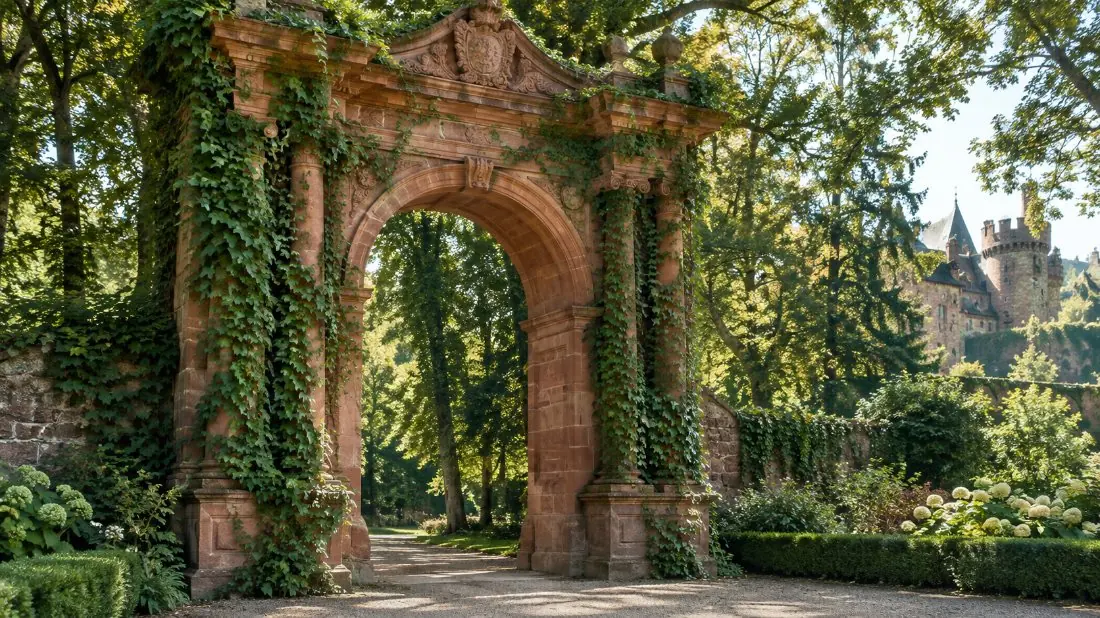
Friedrich V married Elizabeth Stuart, daughter of James I of England, in 1613 and welcomed her to Heidelberg with fireworks, which is why the castle illumination still ends with them. For her he built the Englischer Bau and, in 1615, the Elizabeth Gate in the Stückgarten. Legend says the gate went up in a single night as a birthday surprise; treat that as legend. His last and largest project was the Hortus Palatinus, the terraced garden designed by Salomon de Caus from around 1616, which contemporaries called the eighth wonder of the world. It was never finished. Friedrich accepted the Bohemian crown in 1619, lost it at the Battle of White Mountain in 1620 and never came home.
| Building | Built | For | What to look for |
|---|---|---|---|
| Ottheinrichsbau | From 1556 | Elector Ottheinrich | The statue facade; the Apothecary Museum is in its cellar |
| Gläserner Saalbau (Hall of Glass) | Mid 16th century | Friedrich II | Arcades; Graimberg's tower room |
| Friedrichsbau | 1601 to 1607 | Friedrich IV | Sixteen ancestor statues; the restored interiors |
| Englischer Bau | After 1613 | Friedrich V and Elizabeth Stuart | The shell above the Great Terrace |
| Elizabeth Gate | 1615 | Elizabeth Stuart | Carved arch in the Stückgarten, free to visit |
| Hortus Palatinus | From about 1616 | Friedrich V | The surviving terraces, free in daylight |
What happened at Heidelberg Castle in 1689 and 1693?
French troops of Louis XIV set it on fire on 2 March 1689 and blew the front off the Fat Tower. They came back in May 1693 and mined the remaining towers and walls.
The castle had already suffered. In the Thirty Years' War Tilly took the town on 16 September 1622 and the castle a few days later; the Swedes held it from 1633, imperial troops from 1635, and Elector Karl Ludwig returned to a damaged seat in 1649. The real destruction came in the War of the Palatine Succession, when Louis XIV pressed a claim to the Palatinate through his sister-in-law.
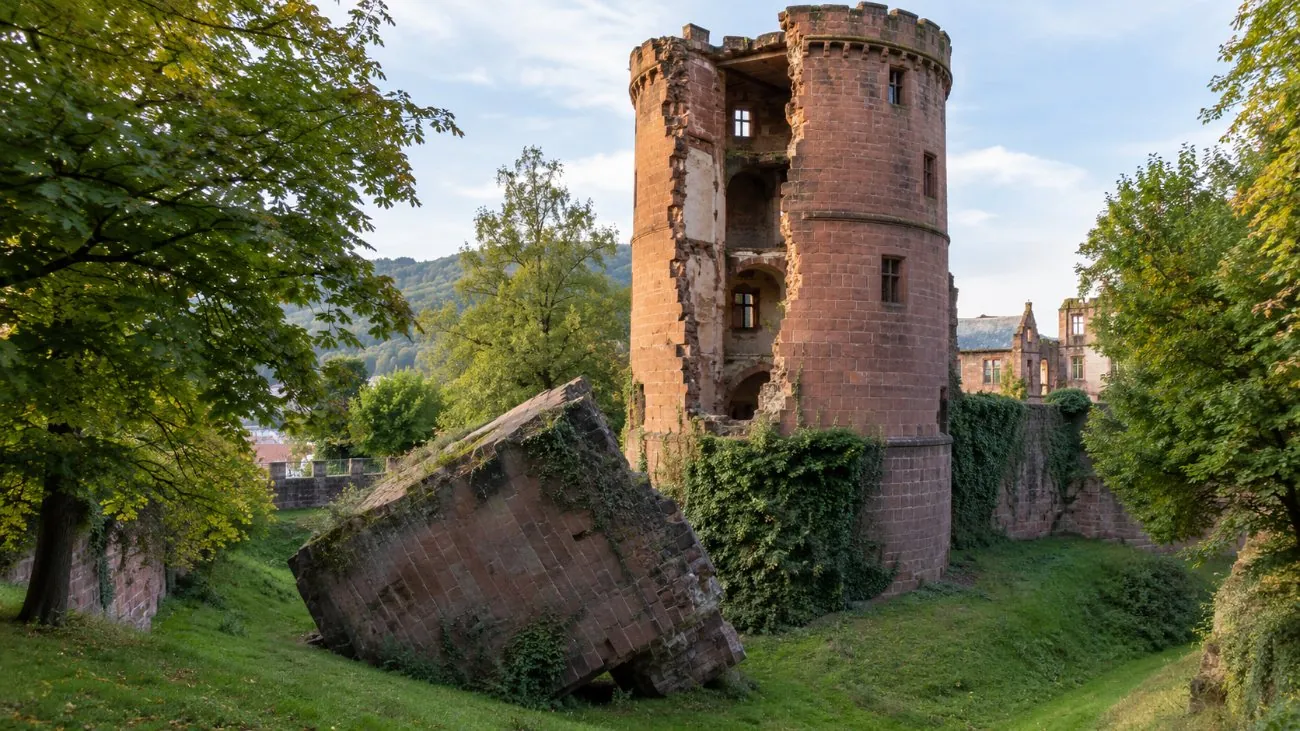
Withdrawing from Heidelberg in 1689, the French fired the castle on 2 March and blew up the front of the Fat Tower. Four years later they retook the town on 22 May 1693, the castle surrendered the next day, and this time they did the job with mines, bringing down towers and walls across the site. The Krautturm, the Powder Tower, split in two and half of it slid into the moat, where it still lies. The red light of the summer castle illumination recalls the burning of castle and town in those two years.
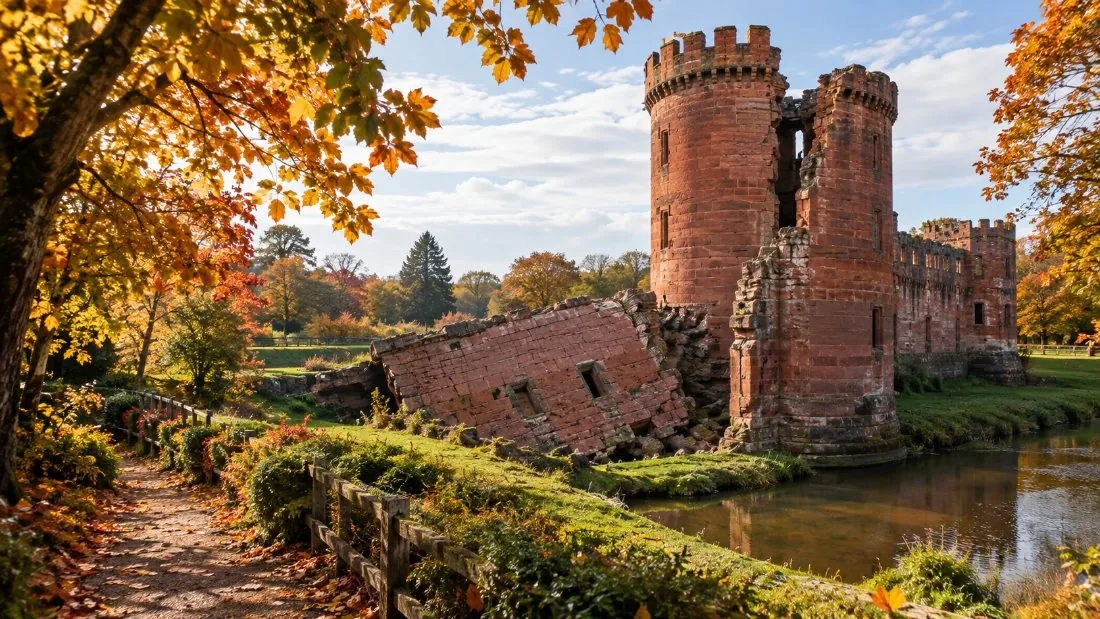
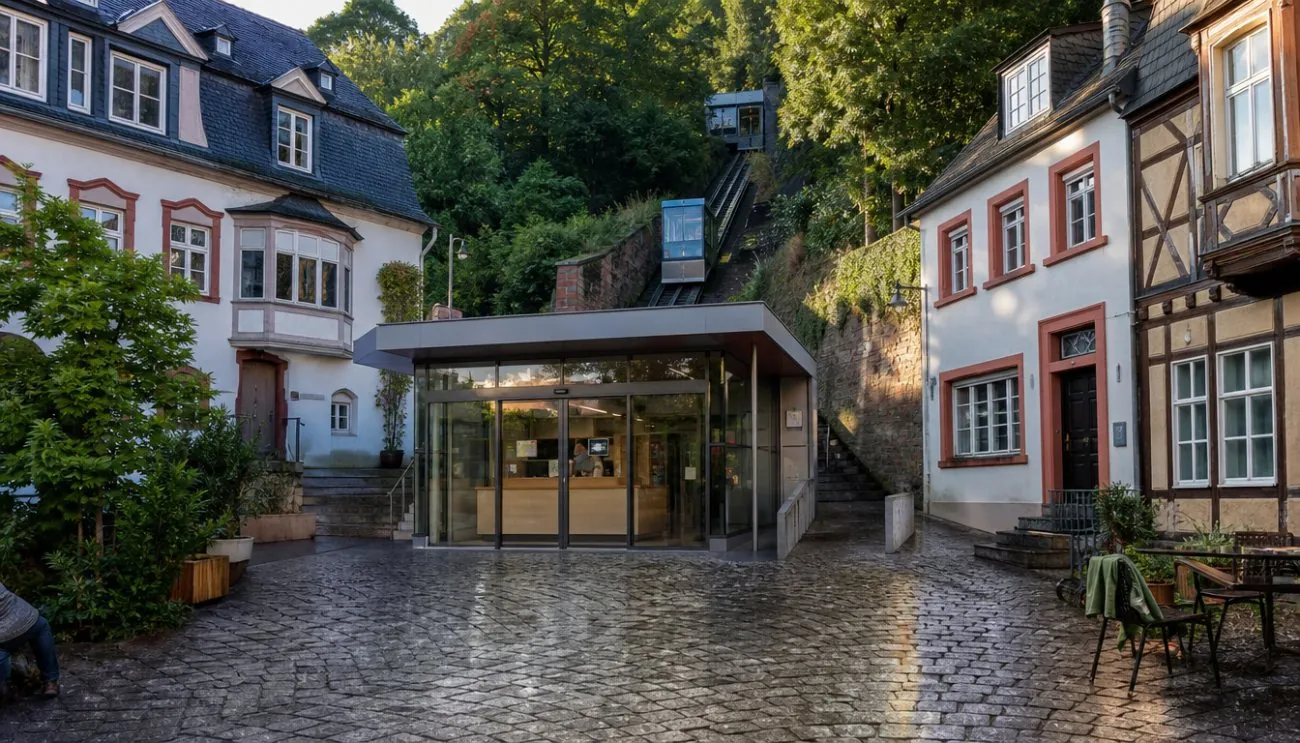
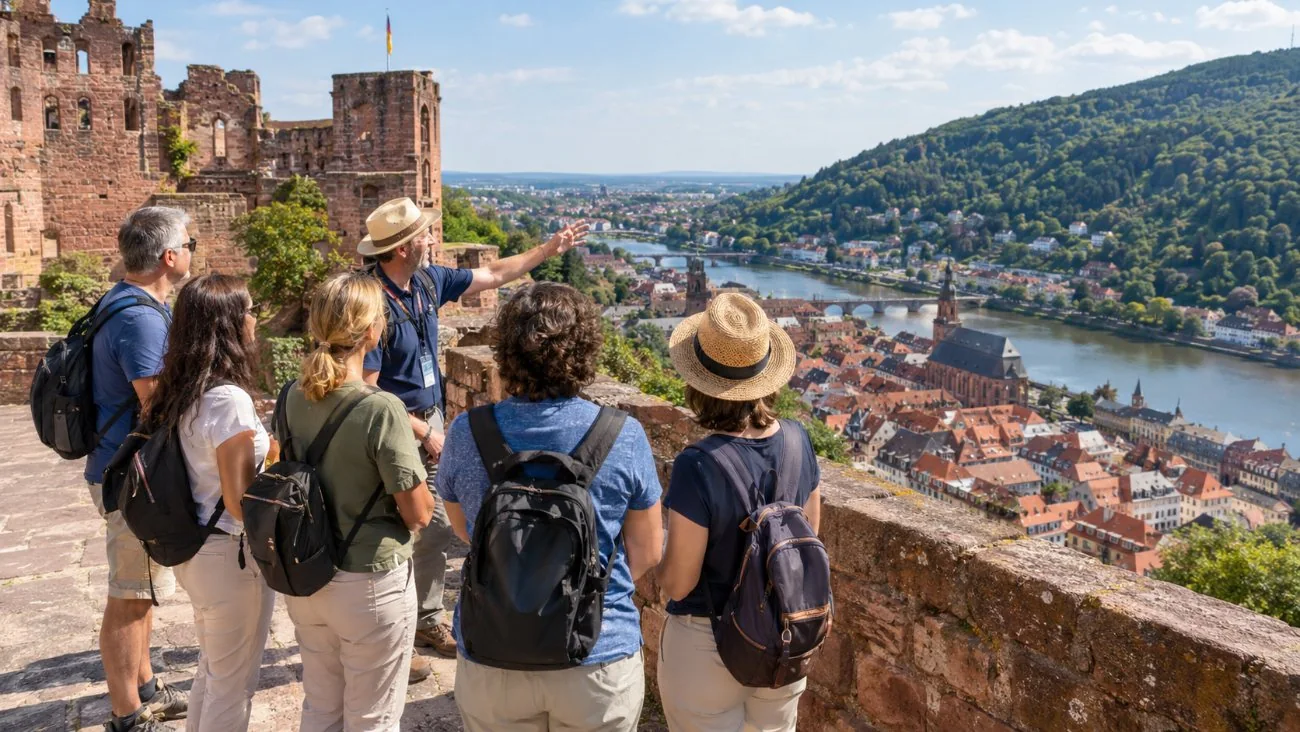
Hear the 1689 and 1693 story on the spot: the two-hour guided walk puts you in front of the split tower with a guide in English or German, castle ticket and funicular included.
Book thisWhy was Heidelberg Castle never rebuilt?
Because the court left, lightning struck, the town quarried the stone, and in 1890 a commission ruled that the ruin should stay a ruin. The Friedrichsbau alone was restored.
Elector Karl Philipp moved the court to Mannheim in 1720, a flat new city with room for a baroque palace. Heidelberg got provisional repairs and a plan, under Karl Theodor, to move back one day. On 24 June 1764 two lightning strikes set the castle on fire and ended the plan. From then on the ruin was a quarry. Townspeople took stone, timber and iron; the south wall was carted off for Schwetzingen Palace as early as 1767; in 1784 the vaults of the Ottheinrichsbau were filled in so the stone could be reused.
The man who stopped it was Charles de Graimberg, a French count and engraver in exile who arrived after 1810 and stayed for the rest of his life. He moved into a tower room in the Hall of Glass in 1811, acted as voluntary castle warden until 1822, guarded the ruin against stone-taking when the Baden authorities refused to pay a guard, financed excavations and a collection of finds, and had the first castle guidebook written. His drawings carried the ruin's image across Europe.
In 1868 a poet called for complete reconstruction and set off the Heidelberg monument dispute. Baden set up an office for the castle in 1883. In 1890 a commission of specialists concluded that rebuilding was not feasible and that the castle should be preserved in its ruined state, with the exception of the Friedrichsbau, which Karl Schäfer restored between 1897 and 1900 and refurnished in the Historicist taste of the day. What you see today is that decision, held to for over a century.
| Year | Event |
|---|---|
| 1225 | First documented mention (castle's own history) |
| 1537 | Upper castle destroyed by lightning |
| 1556 | Ottheinrichsbau begun |
| 1601 to 1607 | Friedrichsbau built |
| 1613 to 1616 | Elizabeth Stuart arrives; Elizabeth Gate; Hortus Palatinus begun |
| 1622 | Tilly takes town and castle in the Thirty Years' War |
| 2 March 1689 | French fire the castle and blow up the Fat Tower |
| May 1693 | French retake Heidelberg and mine the towers and walls |
| 1720 | Court moves to Mannheim |
| 24 June 1764 | Lightning sets the castle on fire |
| 1767 onwards | Ruin quarried for Schwetzingen and the town |
| 1811 to 1864 | Charles de Graimberg lives in the castle and protects it |
| 1868 | Call for reconstruction starts the monument dispute |
| 1890 | Commission decides to preserve the castle as a ruin |
| 1897 to 1900 | Friedrichsbau restored by Karl Schäfer |
Who made Heidelberg Castle famous?
The Romantics. Around 1800 Hölderlin, Eichendorff, Goethe and Turner turned the ruin into an image of lost greatness, and Mark Twain carried it to America in 1880.
Goethe visited Heidelberg eight times between 1775 and 1815; a ginkgo in the garden is linked to his 1815 meeting there with Marianne von Willemer. Hölderlin wrote his ode to the town. Eichendorff studied here. Turner came several times between 1817 and 1844 and painted the castle, often setting it higher on the hill than it really stands, which tells you what he thought the picture needed. Graimberg's own engravings sold the view to the rest of Europe.
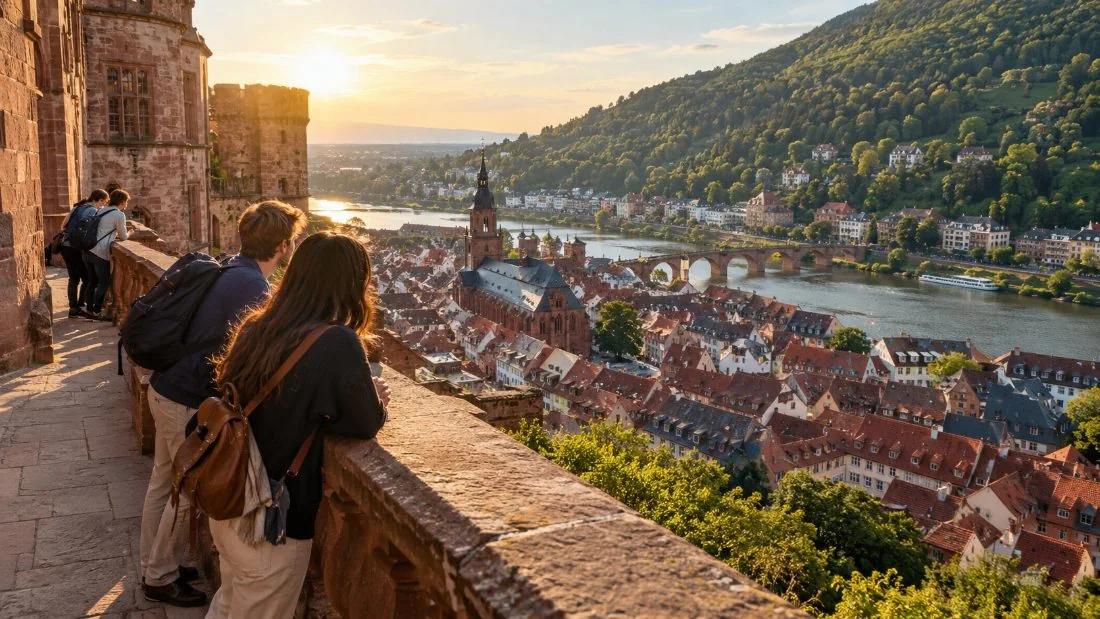
Then the Americans arrived. Twain spent part of 1878 in Heidelberg and devoted chapters of "A Tramp Abroad" to the castle, the Tun and the view from the hill. The ruin became a fixed stop on the European tour, and the town built hotels to match. The painters' viewpoint is still the best one: the Philosophenweg on the north bank, or the Old Bridge at dusk, as in our visiting guide.
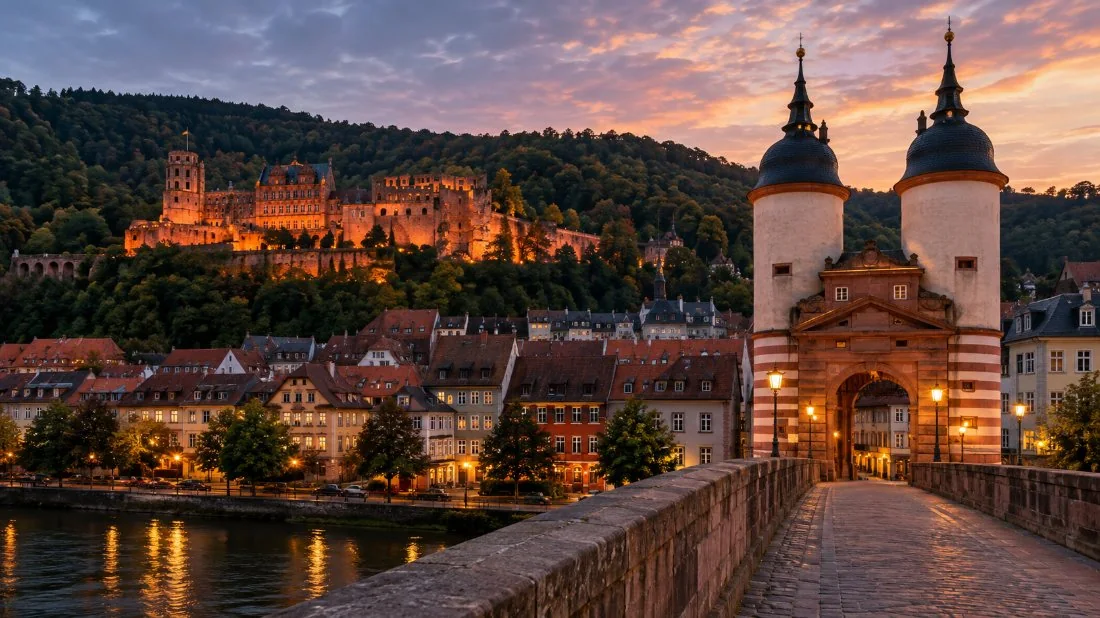
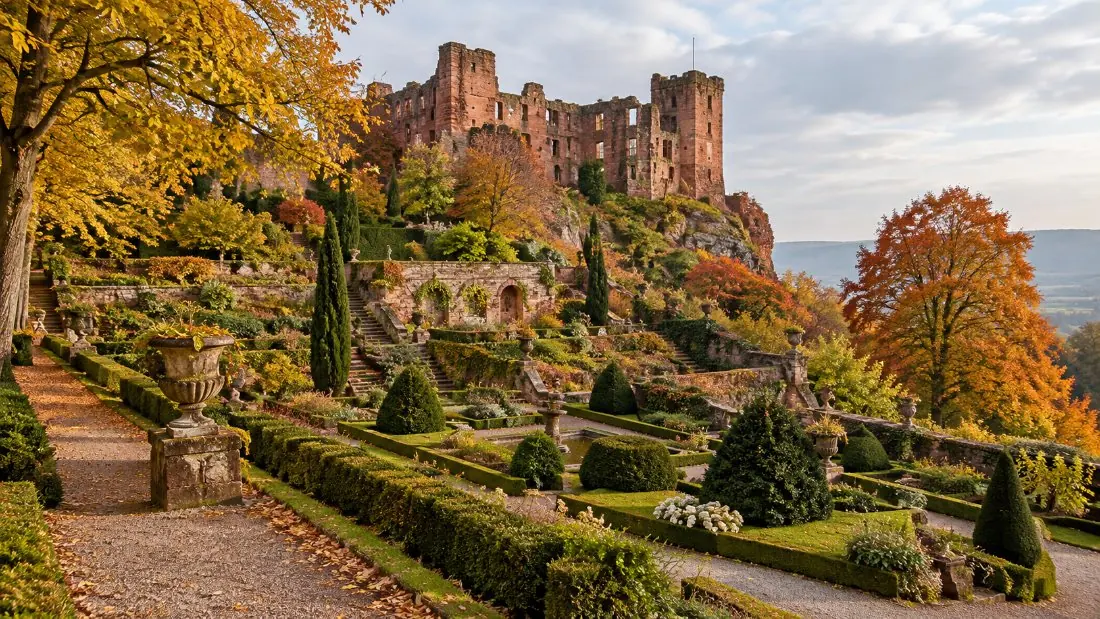
A private guide for the whole story, from Ottheinrich to Graimberg, at your own pace through the garden, the ruins and the cellar. Tickets and cable car included.
Book this Tour detailsWhat is the Great Tun, and who was Perkeo?
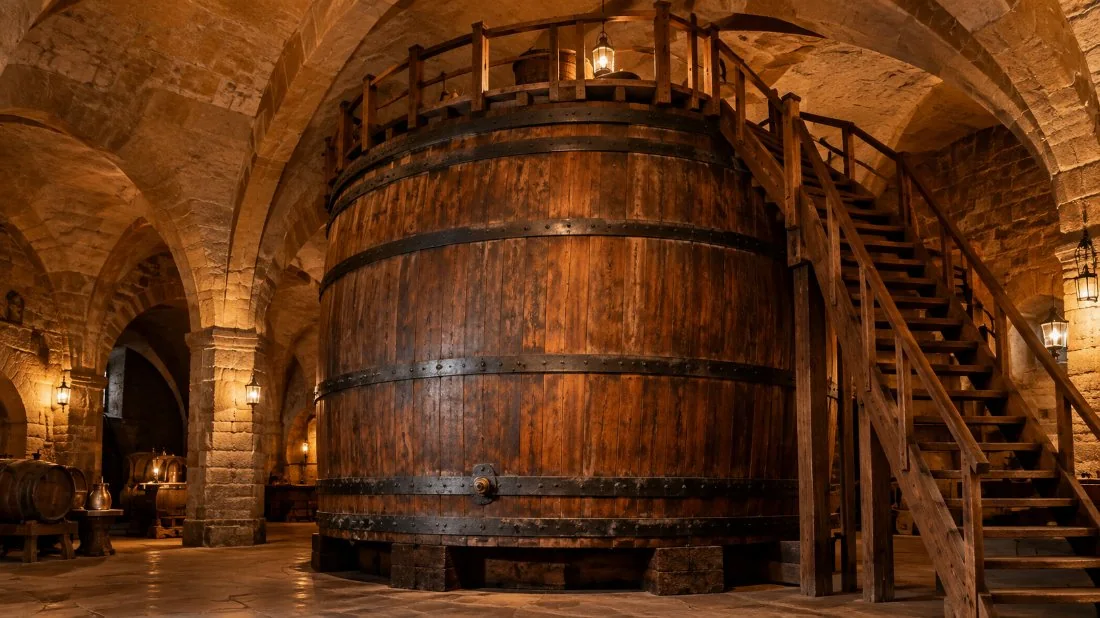
A wine barrel of roughly 220,000 litres built in 1751 for Elector Karl Theodor, the fourth giant barrel in the castle cellar. Perkeo was the court jester said to have guarded it.
The electors took wine as tax from the Palatinate vineyards and needed somewhere to put it. The first great barrel was built in 1591, the second in 1664, the third in 1728 and the current one in 1751 for Karl Theodor: about seven metres high, eight and a half long, built from around 130 oak trees according to tradition, and holding roughly 220,000 litres when new. The castle calls it the largest wine barrel in the world; a barrel in Bad Dürkheim is bigger but was built as a restaurant and never held wine. A staircase climbs to a platform on top that served as a dance floor. The barrel stands empty and has for a very long time.
Opposite it stands the wooden figure of Perkeo, the Tyrolean court dwarf and jester Clemens Pankert, who according to the stories kept the cellar and drank a heroic share of its contents. His name is said to come from his answer when offered another glass: "perche no", why not. The figure, the barrel and the stories are on the castle ticket and on every guided tour.
Who owns Heidelberg Castle today?
The State of Baden-Württemberg, through its agency Staatliche Schlösser und Gärten. Around a million people a year visit.
The castle passed with the Palatinate to Baden in the Napoleonic reshuffle and to the state of Baden-Württemberg after 1952. The Staatliche Schlösser und Gärten runs it, sells the ticket, runs the interior tours and keeps the ruin standing, which is a permanent job: red sandstone weathers fast, and the maintenance notices on the castle's visitor information page are a regular feature.
The twentieth century was kind to it. Heidelberg was not bombed to ruins in the Second World War; the Wehrmacht blew up the Neckar bridges, including the Old Bridge, which was rebuilt by 1947, and the US 63rd Infantry Division entered the town at the end of March 1945. The castle came through untouched and spent the post-war decades as the backdrop to one of the largest American garrisons in Europe, which is one reason so many Americans know it.
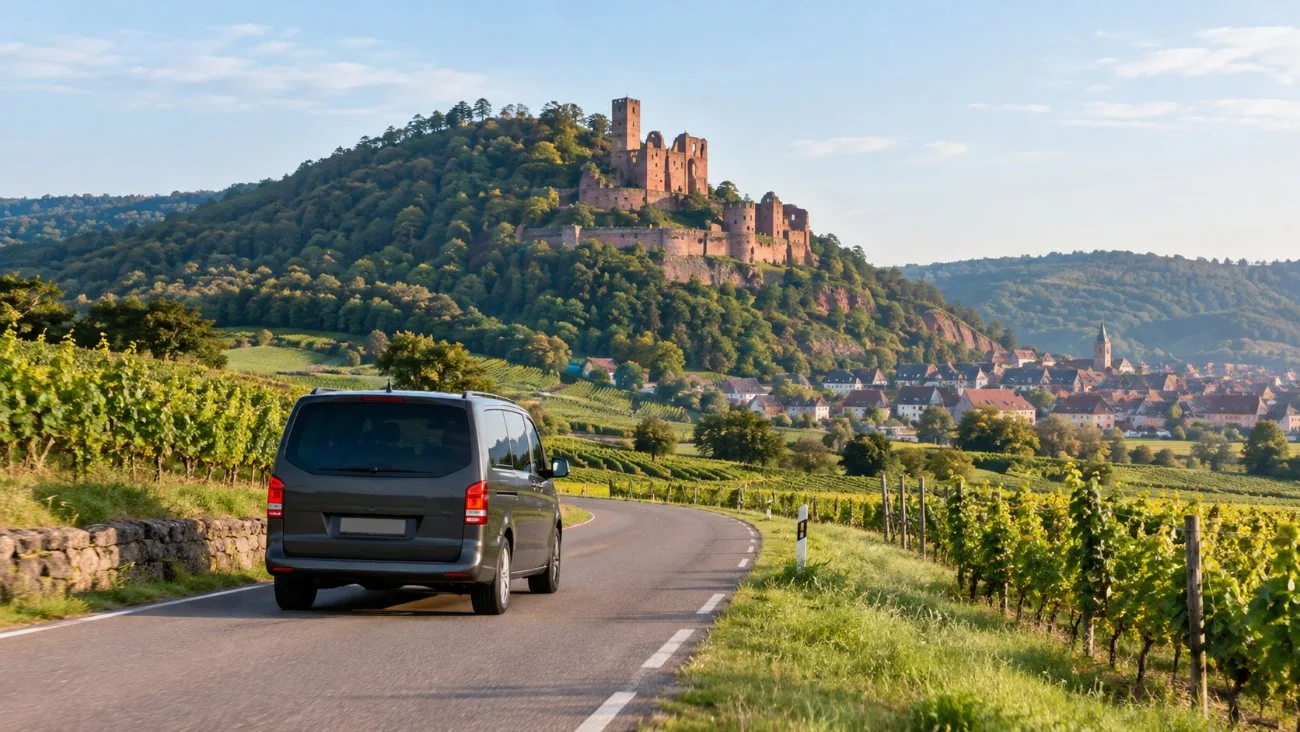
See the city and the castle in one go: an hour of Heidelberg by bus with a German-speaking guide, an hour in the castle grounds and the funicular back down.
Book thisFrequently asked questions
When was Heidelberg Castle destroyed?
Twice by the French, in 1689 and 1693, and finally by lightning on 24 June 1764. The 1689 fire and the 1693 mines did the structural damage; the 1764 fire ended plans to move the court back from Mannheim.
Why is Heidelberg Castle a ruin?
Because a commission in 1890 decided it should stay one. After the French destruction and the 1764 lightning, the town quarried the ruin for stone until Charles de Graimberg stopped it. The 1890 decision preserved the castle as it stood and restored the Friedrichsbau alone.
Was the Elizabeth Gate really built in one night?
That is the legend. The record says Friedrich V had the gate built in 1615 for his wife Elizabeth Stuart. The one-night birthday story is told on tours and is worth telling, but no source confirms it.
Is the Great Tun the largest wine barrel in the world?
The castle says so. The barrel in Bad Dürkheim has a larger volume but was built as a restaurant and never held wine. Call the Heidelberg Tun one of the largest wine barrels ever built and nobody will argue.
Ready to book
Choose your tour
Each option opens on GetYourGuide with the operator named and the inclusions listed.
Discover Heidelberg Castle: Guided Walk
- Funicular ride from the Kornmarkt to the castle
- Castle courtyard, Great Terrace and Great Tun cellar
- German Apothecary Museum admission
Residence of the Electors: Private Castle Tour
Your own guide through garden, ruins and cellar; the listing says wheelchair accessible